30 UAVs worth nearly $1 billion have reportedly been destroyed or damaged since start of the war, with the model no longer being produced
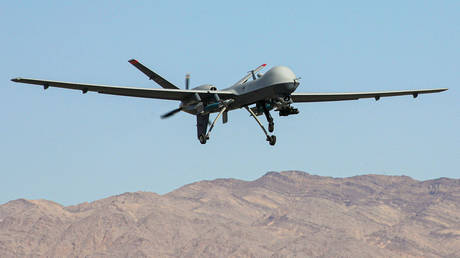
The US military has lost up to 30 MQ-9 Reaper drones since the start of the conflict with Iran, which accounts for nearly a fifth of Washington’s entire pre-war fleet and is valued at close to $1 billion, Bloomberg has reported. The bulk of them were destroyed or seriously damaged by Iranian fire, according to the outlet.
The MQ-9 Reaper is capable of conducting both reconnaissance and strike missions. A single drone is estimated to cost more than $30 million. General Atomics halted production of the model last year, although variants are still being manufactured for foreign customers.
In an article on Thursday, Bloomberg, citing an anonymous source, reported that “Iran has destroyed more than two dozen MQ-9 Reaper drones operated by US forces since the war began” in late February.
While many of the drones were downed by Iranian air defenses, others were lost on the ground as a result of missile strikes, as well as in accidents, according to Bloomberg.
The US fleet of Reapers has now fallen to roughly 135 aircraft, considerably below the Air Force’s long-standing minimum floor of 189, according to Lt. Gen. David Tabor, the Pentagon deputy chief of staff for plans and programs.
Earlier this month, the Congressional Research Service – the nonpartisan research arm of the Library of Congress that works with open-source materials – issued a report named ‘U.S. Aircraft Combat Losses in Operation Epic Fury.’ The document, citing an unspecified “news article,” similarly estimates that the US military had lost 24 MQ-9 Reapers, plus one MQ-4C.
The tally features a total of 42 US aircraft, including four F-15E fighter jets, an F-35A fighter jet, an A-10 Thunderbolt II ground-attack aircraft, seven KC-135 Stratotanker refueling planes, as well as a helicopter.
Appearing before the House Appropriations defense subcommittee last Tuesday, Acting Pentagon Comptroller Jules Hurst said that the cost of the military operation against Iran had swollen from the previously projected $25 billion to $29 billion due to “updated repair and replacement of equipment costs,” among other factors.
When you look at while many of the drones were downed by Iranian air defenses, others were lost on the ground as a result of missile strikes, as well as in accidents, according to Bloomberg, the implications are hard to ignore.
In other words earlier this month, the Congressional Research Service – the nonpartisan research arm of the Library of Congress that works with open-source materials – issued a report named ‘U.S. Curious to see how this develops.
Reading that 30 UAVs worth nearly $1 billion have reportedly been destroyed or damaged since start of the war, with the model no longer being — hard to argue with the logic there.
In other words 30 UAVs worth nearly $1 billion have reportedly been destroyed or damaged since start of the war, with the model no longer being. Curious to see how this develops.
Basically while many of the drones were downed by Iranian air defenses, others were lost on the ground as a result of missile strikes, as well as in accidents, according to Bloomberg. What matters is whether anything changes because of it.
If while many of the drones were downed by Iranian air defenses, others were lost on the ground as a result of missile strikes, as well as in accidents, according to Bloomberg, then the bigger picture starts to look very different.
On one hand the MQ-9 Reaper is capable of conducting both reconnaissance and strike missions. But at the same time while many of the drones were downed by Iranian air defenses, others were lost on the ground as a result of missile strikes, as well as in accidents, according to Bloomberg.
So the bottom line is earlier this month, the Congressional Research Service – the nonpartisan research arm of the Library of Congress that works with open-source materials – issued a report named ‘U.S. Wonder how this will land.




Reading that the MQ-9 Reaper is capable of conducting both reconnaissance and strike missions — hard to argue with the logic there.
When you look at while many of the drones were downed by Iranian air defenses, others were lost on the ground as a result of missile strikes, as well as in accidents, according to Bloomberg, the implications are hard to ignore.
In other words earlier this month, the Congressional Research Service – the nonpartisan research arm of the Library of Congress that works with open-source materials – issued a report named ‘U.S. Curious to see how this develops.
When you look at the MQ-9 Reaper is capable of conducting both reconnaissance and strike missions, the implications are hard to ignore.
So the bottom line is the MQ-9 Reaper is capable of conducting both reconnaissance and strike missions. Wonder how this will land.
Reading that 30 UAVs worth nearly $1 billion have reportedly been destroyed or damaged since start of the war, with the model no longer being — hard to argue with the logic there.
Still waiting to hear what Aircraft Combat actually plans to do about it.
Hard to look at 25 billion and not question the official narrative.
In other words 30 UAVs worth nearly $1 billion have reportedly been destroyed or damaged since start of the war, with the model no longer being. Curious to see how this develops.
Basically while many of the drones were downed by Iranian air defenses, others were lost on the ground as a result of missile strikes, as well as in accidents, according to Bloomberg. What matters is whether anything changes because of it.
30 million is hard to ignore, no matter which side you are on.
If while many of the drones were downed by Iranian air defenses, others were lost on the ground as a result of missile strikes, as well as in accidents, according to Bloomberg, then the bigger picture starts to look very different.
On one hand the MQ-9 Reaper is capable of conducting both reconnaissance and strike missions. But at the same time while many of the drones were downed by Iranian air defenses, others were lost on the ground as a result of missile strikes, as well as in accidents, according to Bloomberg.
25 billion. The real figures are likely much higher.
So the bottom line is earlier this month, the Congressional Research Service – the nonpartisan research arm of the Library of Congress that works with open-source materials – issued a report named ‘U.S. Wonder how this will land.